
Select Page
For years, the center of gravity in computing lived firmly in the cloud. Data streamed upward, models ran in distant data centers, and intelligence flowed back down to devices. But that paradigm is rapidly shifting. Today, a new wave of distributed, intelligent systems is emerging—systems that don’t just send data, but understand, infer, and act right where the action happens.

This wave has a name: edge machine learning, or edge ML. It’s called ‘edge’ because intelligence moves from distant cloud servers to the very edge of the network—onto devices like cameras, robots, and sensors. By placing ML closer to where data is generated, systems gain the ability to make near-instant decisions while strengthening privacy and autonomy.

Whether it’s a smart camera distinguishing objects in milliseconds, a warehouse robot navigating in real time, or an industrial sensor predicting equipment failure on the spot, integrating ML with edge is transforming everyday devices into powerful, context-aware systems. In this blog, we explore how ML at the edge is reshaping modern edge systems, along with how Utthunga helps overcome the associated challenges to build scalable, production-ready edge solutions.

Why ML at the Edge Matters

The real power of machine learning emerges when insights are generated where the data is created. ML at the edge brings computation closer to the source, enabling faster, safer, and more efficient decision-making across industries. Here’s how it helps:

Ultra-Low Latency

ML at the edge enables millisecond-level response times, allowing devices to act on data the instant it is generated. This speed is critical across diverse industrial scenarios, such as:
  • Preventing machine collisions on a fast-moving manufacturing line
  • Monitoring patient vitals in real time to trigger immediate alerts
  • Enabling split-second decisions in advanced driver-assistance systems
  • Detecting anomalies instantly in high-speed industrial processes
By processing data locally in the examples above, ML at the edge delivers consistent, real-time performance—even when networks are congested or connectivity is unreliable.

Enhanced Privacy & Security

With ML at the edge, data is processed locally, eliminating the need to continuously send sensitive information to external servers. This dramatically reduces exposure to data leaks, unauthorized access, and interception risks. The benefits are clear across scenarios such as:
  • Keeping patient health records securely within medical devices or on-premises systems
  • Protecting confidential industrial telemetry from leaving factory floors
  • Securing video analytics on smart cameras without uploading footage to the cloud
  • Maintaining compliance with regulations like GDPR, HIPAA, and industry-specific standards
By ensuring data stays where it’s generated in each of the above cases, ML at the edge strengthens privacy, simplifies compliance, and builds higher levels of operational trust.

Offline Reliability

ML at the edge ensures devices keep working even when cloud connectivity is weak, intermittent, or completely unavailable. Since inference happens locally, systems can continue to make decisions, monitor operations, and execute control tasks without relying on an always-on internet connection. This is essential in scenarios such as:
  • Operating remote industrial equipment in mines, offshore rigs, or isolated plants
  • Running field sensors and instruments in agriculture, oil & gas, or environmental monitoring
  • Maintaining mission-critical machinery on factory floors where downtime is unacceptable
  • Supporting autonomous systems like drones or robots that can’t depend on network coverage
By enabling intelligence that works anywhere, ML at the edge provides the reliability needed for high-stakes, high-uptime environments.

Energy & Cost Efficiency

ML at the edge processes data locally, dramatically reducing the amount of information sent to the cloud. This lowers bandwidth usage, cuts operational costs, and minimizes the power required for continuous communication. Local intelligence also allows for smarter sensing strategies, where devices capture or transmit data only when it truly matters. The impact is especially clear in scenarios like:
  • Extending battery life in portable or remote IoT devices
  • Reducing network load across large fleets of sensors or edge nodes
  • Lowering cloud computing and storage costs for high-volume industrial data
  • Optimizing energy usage in smart buildings, factories, and utilities
By making systems leaner and more efficient, ML at the edge helps organizations reduce both energy consumption and long-term operational expenses.

As a partner, Utthunga brings deep expertise in embedded systems, industrial automation, and AI engineering. This enables us to design Edge ML solutions tailored to the unique demands of each industry.
Why ML at the Edge Matters

Vision at the Edge

ML is bringing powerful visual intelligence directly onto edge devices, enabling rapid interpretation of the physical environment without relying on the cloud. A few common capabilities include:
  • Object detection and tracking for identifying products, people, or machinery in real time
  • Anomaly detection to spot defects, irregular behaviors, or safety risks instantly
Smart cameras equipped with on-device ML can analyze scenes, trigger alerts, and automate decisions locally—reducing bandwidth use and maintaining performance even in low-connectivity environments. This shift is transforming surveillance, quality inspection, traffic monitoring, and industrial automation.

Predictive Maintenance

Industrial equipment is becoming smarter and more self-aware thanks to edge-based ML models running directly on sensors and controllers. Some of the key advancements include:
  • Vibration and acoustic analysis for early detection of wear, imbalance, or misalignment.
  • Real-time fault detection that allows machines to take preventive actions before failures occur.
By keeping inference close to the source of data, facilities can avoid downtime, reduce maintenance costs, and extend equipment life—without needing continuous cloud connectivity.

Autonomous Mobility

From drones to AGVs to warehouse robots, autonomous systems rely heavily on edge ML to understand their surroundings and make instant decisions. This includes:
  • Onboard navigation and path planning
  • Collision avoidance and safety monitoring
  • Environmental perception through real-time vision and sensor fusion
Local processing ensures that mobility systems react with precision and reliability, even in dynamic or complex environments.

Smart Consumer Devices

Everyday devices are becoming more intuitive through embedded ML capabilities, enabling:
  • Context-aware interactions in wearables, smart speakers, and appliances
  • Personalized responses based on user behavior, preferences, or voice inputs
  • Automation and environmental control in smart homes
These devices can interpret audio, movement, or environmental signals directly on-device, improving responsiveness while protecting user data.

Energy & Resource Optimization

ML is driving efficiency across energy-intensive environments by enabling:
  • Adaptive power management in buildings, factories, and utility grids
  • Real-time optimization of HVAC systems, lighting, and energy storage
  • Predictive load balancing based on usage patterns
By making localized decisions about consumption, systems can reduce waste, lower costs, and improve overall sustainability.

Challenges in Embedding Intelligence — and How Utthunga Helps Overcome Them

Bringing ML to the edge unlocks speed, autonomy, and efficiency—but it also introduces a unique set of engineering challenges. Real-world deployments often struggle with the following:
  • Limited compute, memory, and power: Edge devices operate under tight resource constraints.
  • Security for distributed devices: More endpoints mean a larger attack surface.
  • Updating large fleets of devices: Rolling out model and firmware updates at scale is complex.
  • Data drift & model monitoring: Edge models can degrade over time without proper feedback loops.
Successfully navigating these challenges requires both technical depth and domain understanding.

Utthunga brings a combination of embedded engineering, industrial know-how, and ML expertise to streamline your edge intelligence journey. We help organizations:

  • Start with lightweight, efficient models suited for constrained hardware
  • Optimize sensor data pipelines to reduce noise, latency, and energy use
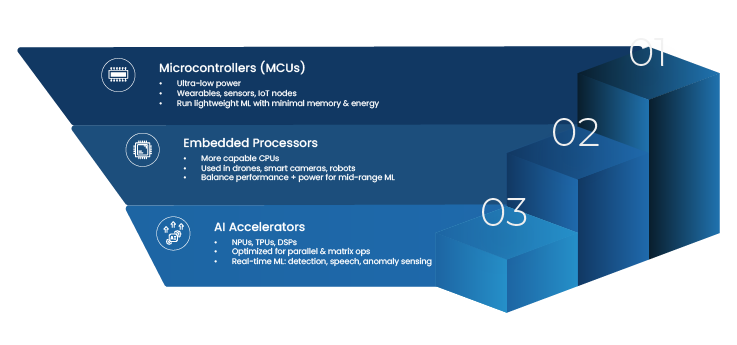
  • Design models hardware-aware to leverage MCUs, embedded processors, or accelerators effectively
  • Adopt robust Edge MLOps practices for deployment, monitoring, and updates
  • Validate real-time performance & robustness across real industrial conditions
Through this integrated approach, Utthunga ensures your edge ML solutions are scalable, secure, and production-ready, no matter how complex the environment. To know more about our approach and success stories, get in touch with us here.