

Snippet:
Next-generation product optimization turns insights into action, scaling performance, reliability, and customer value across the product lifecycle. By combining engineering expertise, data-driven analytics, and continuous improvement, organizations achieve faster adoption, resilient products, and measurable growth. Embedding optimization from design through sustainment creates future-ready solutions that enhance customer experience and expand market share.
What separates leaders from laggards is not the frequency of releases, but the ability to optimize products holistically—across performance, reliability, experience, and speed to value. Product decisions now directly influence revenue growth, customer retention, and brand credibility. As a result, optimization can no longer be episodic or reactive. It must become a continuous, data-driven discipline embedded across the product lifecycle. Organizations that still treat optimization as a post-launch activity risk falling behind competitors that design for performance and scale from the outset.
When Product Performance Becomes the Brand
Even small inefficiencies can have outsized consequences when multiplied across thousands or millions of users. Performance issues dampen renewal rates, limit advocacy, and weaken the influence of customers who shape broader market perception. In this environment, marketing narratives cannot compensate for inconsistent experiences.
Leadership teams must therefore move away from feature-centric roadmaps focused on output volume, and toward outcome-driven optimization that emphasizes reliability, usability, and measurable customer value.
Research by Forrester shows that companies leading in customer experience grow revenue significantly faster than their peers, underscoring the direct link between product performance and brand strength.
Source: Forrester, Customer Experience Index
What “Next-Generation Product Optimization” Really Means
Traditional optimization focuses on isolated improvements. Next-gen optimization is predictive by design. It anticipates opportunities, identifies emerging customer needs, and highlights scalability enhancements before they impact the market. This enables leaders to make faster, better-informed decisions while maximizing value delivery.
Equally important, next-gen optimization spans the entire product lifecycle. From early design decisions to deployment and long-term sustainment, optimization becomes a continuous loop, ensuring that products evolve in line with real user needs and business goals.
The Growth Equation: How Optimization Directly Doubles Customer Satisfaction
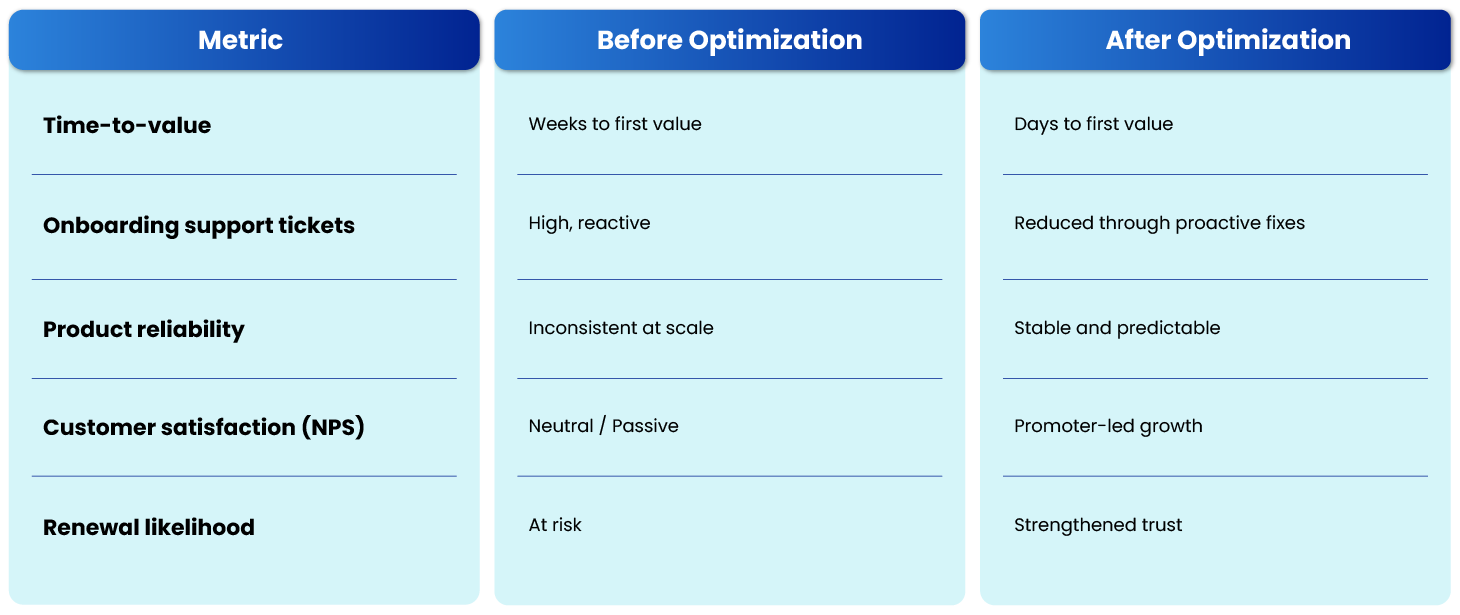
Faster time-to-value sets the stage. Customers buy products to solve urgent problems—not to explore features. When onboarding is smooth, integrations work, and performance is stable, users hit their “aha” moment sooner.
For example, a mid-market SaaS platform serving operations teams cut onboarding time by over 50% by reengineering workflows and fixing friction points. The outcome: happier users, faster activation, and earlier expansion conversations with account owners.
Reliability at scale is the second pillar. Even small performance glitches multiply as your customer base grows, eroding trust. Optimized products anticipate stress and prevent issues before they impact users. The payoff: higher renewal rates, lower churn, and more confidence in mission-critical environments.
Friction-free experiences matter too. Customers don’t leave because of one big failure—they leave because of repeated small obstacles. Streamlined interfaces, faster responses, and alignment between sales promises and product reality reduce friction and make the experience effortless.
Together, speed, reliability, and low friction do more than drive satisfaction—they build advocacy. Customers who trust your product become vocal supporters, accelerating market growth and customer loyalty.
Market Share Expansion: Winning Where Competitors Fall Short
Faster entry → faster adoption
Did you know?
Gartner research shows that B2B buyers increasingly favor products that deliver clear value quickly, even over feature-rich alternatives that take longer to implement.
Source : Gartner
Higher adoption, lower churn
It is primarily because of this reason that high-performing companies embed optimization into their product strategy from the start. Laggards rely on periodic fixes and react only after customers complain. By then, expectations have moved on — and catching up becomes expensive and slow.
CX Insight
Forrester research links strong, consistent product experiences with faster growth and stronger market positions.
Source: Forrester Customer Experience Index
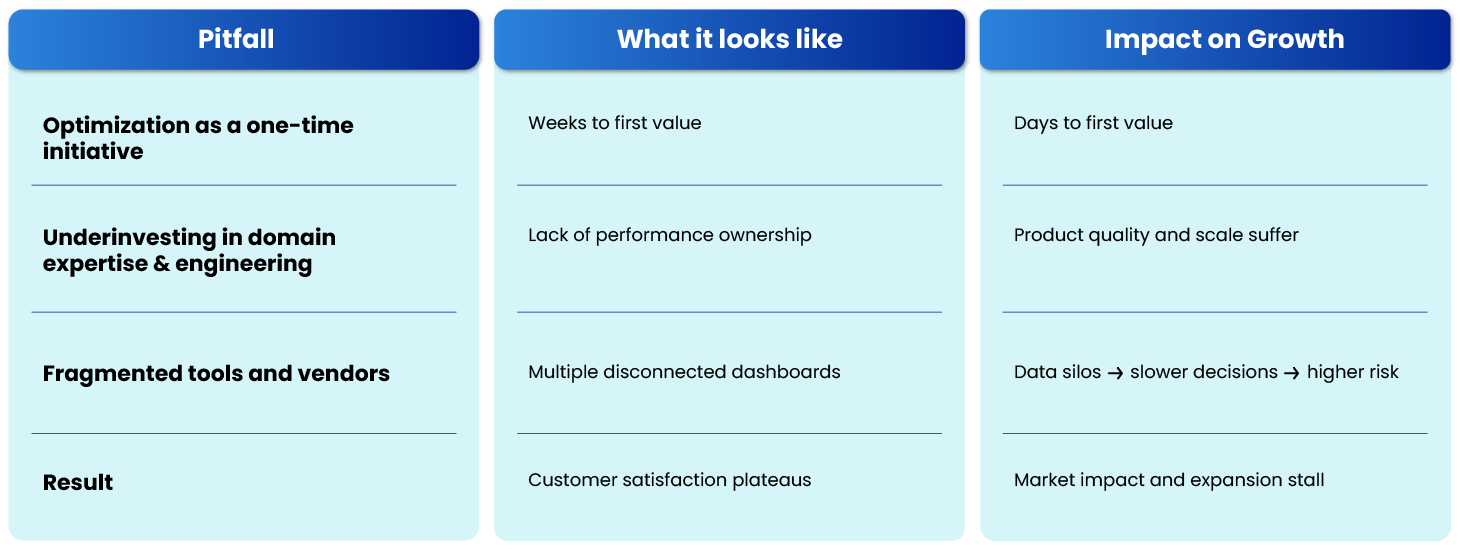
Common Leadership Pitfalls That Stall Product-Led Growth
What Decision-Makers Should Demand from a Product Optimization Partner
Deep domain and engineering expertise
Proven ability to scale optimization across complex products
Data-driven, outcome-focused engagement models
End-to-end ownership across the product lifecycle
Strategic alignment with business KPIs — not just technical metrics
Partners that meet these criteria don’t just optimize products — they enable sustained growth in customer satisfaction and market share. This is where next-gen product optimization moves beyond theory into execution.
Why Utthunga Enables 2X Growth Through Next-Gen Product Optimization
Utthunga exemplifies this model by combining full-spectrum engineering depth with deep industrial domain expertise to deliver optimization across the entire product lifecycle. With over 18 years of experience and a 1,200+ strong multidisciplinary engineering team, Utthunga works as an extension of product organizations — from design and development through deployment, scaling, and long-term sustainment of complex industrial products and digital systems.
Rather than focusing on isolated performance fixes, Utthunga applies a data-driven, outcome-centered approach to optimization. Advanced analytics, AI frameworks, and automation accelerators are used to shorten time-to-value, improve reliability at scale, and continuously align product improvements with business-critical KPIs such as adoption, uptime, and customer satisfaction.
For businesses, this approach translates into measurable business impact: faster onboarding and fewer product issues that elevate customer experience, scalable and resilient products that support market expansion, and future-ready portfolios designed to adapt as technology and customer expectations evolve. By integrating optimization from sensor to cloud and owning outcomes across the lifecycle, Utthunga enables product leaders to turn next-gen optimization into sustained growth — not just better metrics, but stronger market position.
Contact us to know more about our services.