
Nagesh Shenoy
Chief Technology Officer
Utthunga
By 2030, the question will no longer be “Where can we use AI?” It will be “How deeply is AI embedded across our engineering workflows?”
For industrial organizations, this shift represents a significant opportunity. Engineering teams are already dealing with increasing product complexity, aging infrastructure, massive volumes of operational data, cybersecurity requirements, shorter development cycles, and growing pressure to improve productivity.
From AI Experiments to AI-Native Engineering
This is the transition from AI as a tool to AI as an engineering collaborator.
Where AI Will Transform Engineering Workflows?
1. AI-Driven Product Engineering
Engineering teams can use AI to identify patterns across previous projects, recommend reusable components, generate engineering documentation, and detect design anomalies. For OEMs, this can help reduce development cycles while improving product quality and consistency.
2. Intelligent Software Engineering
3. Smarter Plant and Process Engineering
4. AI-Enabled Engineering Knowledge
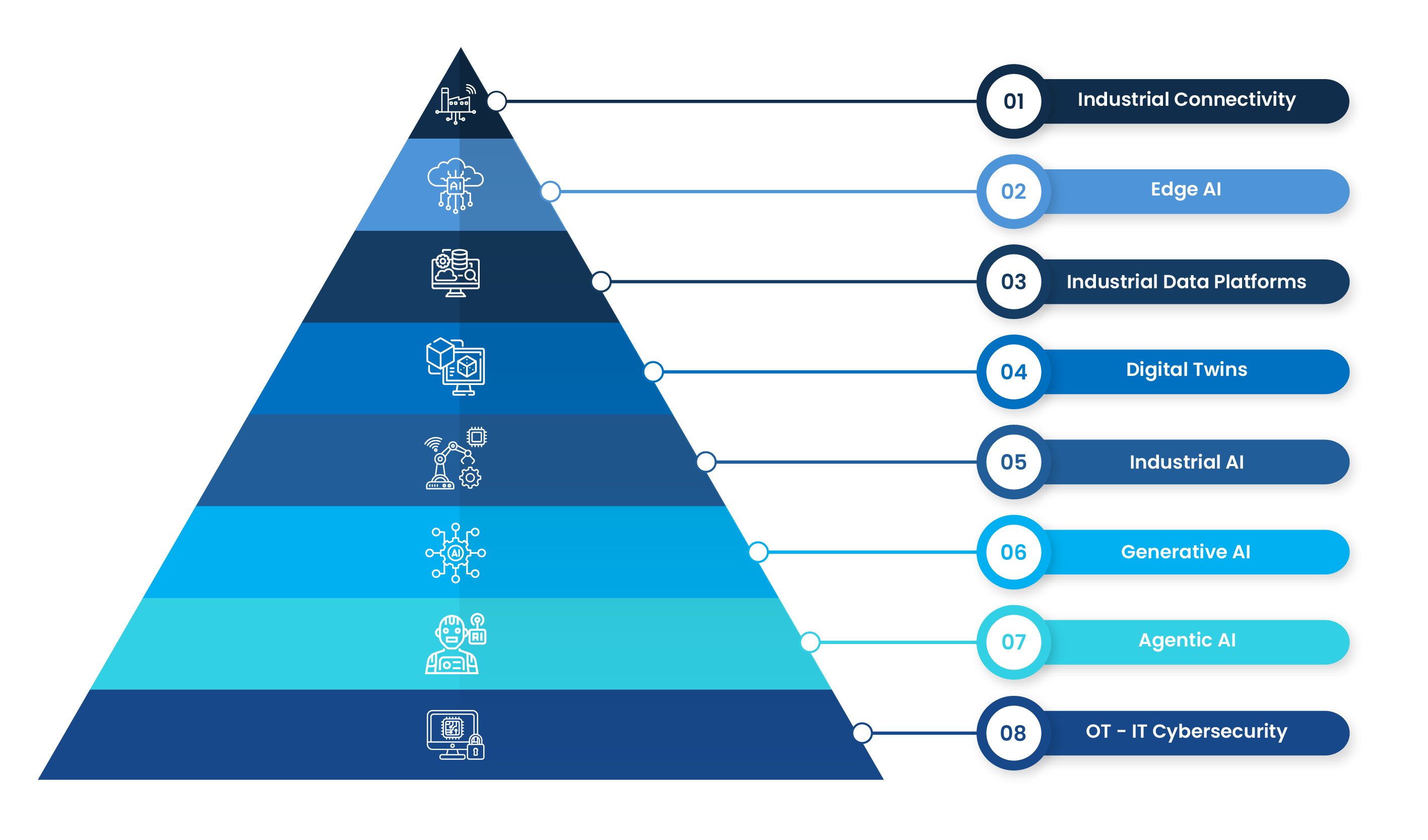
The Technology Foundation for AI-Driven Engineering
How Utthunga Helps Organizations Move Toward AI-Driven Engineering?
We bring together capabilities across Digital Engineering, Industrial AI, Agentic AI, Industrial Connectivity, Digital Twin, Data Analytics, Cloud Transformation, and OT-IT Cybersecurity to help organizations address complex engineering and industrial challenges.
Connecting Industrial Data and Systems
We assist organizations in connecting industrial devices, controllers, applications, and enterprise systems to create a stronger foundation for AI and advanced analytics. By enabling connectivity and OT-IT integration, organizations can bring together fragmented operational and engineering data.
Applying AI to Real Engineering Challenges
These can include predictive maintenance, anomaly detection, asset performance, engineering knowledge management, process optimization, AI-assisted software engineering, and intelligent decision support.
The objective is to connect AI capabilities with measurable engineering outcomes.
Combining AI With Engineering Domain Expertise
Enabling the Next Generation of AI
Moving From Pilots to Scalable Solutions
The Human Factor Will Remain Critical
Routine analysis, information retrieval, documentation, testing, and repetitive development tasks can increasingly be augmented by AI. Engineers can then focus more on system thinking, innovation, problem-solving, validation, and complex decision-making.
However, this requires a cultural shift.
Organizations must create an environment where engineers understand AI capabilities and limitations. AI-generated outputs cannot automatically be treated as correct, particularly in safety-critical and mission-critical environments.
Human expertise, domain knowledge, and engineering judgment will remain essential.
The future is therefore not human versus AI. It is engineer + AI.
Is Your Organization Ready for 2030?
- Is our engineering data accessible, contextualized, and trustworthy?
- Are our legacy systems ready to connect with modern AI technologies?
- Do our engineering workflows have clearly defined opportunities for AI augmentation?
- Do we have the cybersecurity and governance framework required for responsible AI adoption?
- Are our engineers equipped to work effectively with AI?
Building the Engineering Organization of the Future
The journey toward 2030 does not require organizations to transform everything at once. The smarter approach is to identify high-value engineering use cases, establish the required data and connectivity foundation, validate measurable outcomes, and progressively scale successful applications.
By 2030, AI may be as fundamental to engineering as software, automation, and digital connectivity are today.
The future of engineering will not simply be AI-powered. It will be AI-integrated, domain-aware, connected, and increasingly autonomous.
Is your organization ready to engineer with AI?
Connect with us to know how we can help you identify high-value AI opportunities, strengthen your technology foundation, and integrate AI into engineering workflows.