

Author
Manjunath Rao
Vice President & Head – Process and Plant Engineering Services
Utthunga
Vertical: Process & Plant Engineering
Industrial projects are becoming increasingly complex, while project owners are under growing pressure to deliver facilities faster, control capital expenditure, improve safety, and achieve operational readiness with fewer delays.
In this environment, Front End Engineering Design (FEED) plays a critical role. FEED is not simply an engineering phase between concept development and detailed engineering. It is where critical project decisions are made decisions that can directly influence project cost, schedule, constructability, procurement, commissioning, and long-term plant performance.
A well-executed FEED establishes a clear technical foundation for the project. It aligns process requirements, engineering disciplines, equipment specifications, project interfaces, execution strategy, and operational considerations before significant capital is committed.
When done effectively, FEED can help organizations identify risks earlier, minimize engineering changes, reduce rework, and create a more predictable path from concept to commissioning.
The question is: How can organizations make FEED more effective and use it as a lever for faster industrial project delivery?
Current Industry Situation: Why is FEED becoming a strategic project lever?
Traditional FEED approaches can sometimes focus heavily on producing engineering deliverables without sufficiently addressing constructability, procurement, commissioning, operations, and lifecycle requirements.
As a result, unresolved decisions may move into detailed engineering or construction, where changes become more expensive and disruptive.
The industry is therefore moving toward integrated, multidisciplinary, and digital-first FEED approaches. These approaches bring engineering, project execution, procurement, construction, commissioning, and operations considerations into the early stages of project development.
The objective is simple: make the right decisions earlier to avoid costly problems later.
Key Challenges: What can slow industrial projects after FEED?
1. Scope Uncertainty Can Trigger Downstream Rework
Unclear project requirements and poorly defined engineering boundaries can lead to scope changes later in the project. Establishing a clear design basis, process requirements, equipment philosophy, utilities, performance criteria, and project interfaces during FEED is essential.
2. Engineering Silos Create Costly Interface Gaps
Industrial projects require close coordination between process, mechanical, piping, electrical, instrumentation, automation, structural, and other disciplines.
When these teams work in silos, design inconsistencies and interface issues can remain undetected until later stages, resulting in rework and schedule delays.
3. Designs May Not Be Ready for Construction
A technically correct design is not necessarily an execution-ready design.
Equipment access, installation requirements, transportation constraints, modularization, construction sequencing, maintenance access, and site conditions should be evaluated during FEED to ensure that the proposed design can be efficiently built and commissioned.
4. Procurement Risks Can Become Schedule Risks
Long-lead equipment can become a major constraint on project schedules. Delayed specifications, vendor selections, technical clarifications, and vendor data can affect downstream engineering and construction.
Early identification of critical equipment and alignment between engineering and procurement can significantly improve schedule predictability.
5. Disconnected Engineering Data Slows Decision-Making
Engineering information is often distributed across drawings, specifications, equipment databases, 3D models, documents, and multiple project systems.
Without consistent information management, project teams can spend considerable time validating data, resolving inconsistencies, and determining which information is current.
6. Operational Requirements Enter the Project Too Late
Operations and maintenance requirements are sometimes considered only toward project completion. This can result in difficult-to-access equipment, poor maintainability, inadequate instrumentation, or inefficient operating procedures.
Bringing operations perspectives into FEED helps ensure that the final facility is designed not only to be built but also to operate effectively.
7. Digital and Cybersecurity Requirements Are Often an Afterthought
Modern industrial facilities increasingly depend on automation, industrial networks, connected systems, and digital platforms.
If digital architecture, connectivity, cybersecurity, and automation requirements are introduced too late, organizations may face costly redesign and integration challenges.
How Utthunga help turn FEED into an execution-ready foundation?
Faster project delivery starts with better engineering decisions. Utthunga approaches FEED as an integrated engineering activity that connects technical design with project execution, constructability, procurement, commissioning, and lifecycle requirements.
Integrating Engineering Decisions Across Disciplines
Utthunga brings together multidisciplinary engineering capabilities across process, mechanical, piping, electrical, instrumentation, automation, and other engineering functions. This integrated approach helps identify design interfaces and potential conflicts early, reducing downstream engineering changes and improving project coordination.
Bringing Digital Intelligence into Engineering
Digital engineering tools, 3D modeling, engineering data management, digital documentation, and connected workflows can improve collaboration and engineering visibility.
A digital-first approach helps project teams access consistent information, improve design coordination, and make faster decisions throughout the engineering lifecycle.
Designing for Constructability from the Start
Utthunga considers how the design will ultimately be constructed, commissioned, operated, and maintained.
Constructability considerations such as equipment placement, accessibility, modularization, installation requirements, maintenance access, and site constraints can be addressed earlier, helping minimize costly modifications during construction.
Validating Process and Design Decisions Early
Early engineering validation can help identify design limitations before they affect downstream activities.
Process simulation, engineering reviews, design verification, safety studies, and process optimization can provide greater confidence in key design decisions and help reduce uncertainty before detailed engineering begins.
Connecting FEED to the Complete Project Lifecycle
FEED should not be treated as an isolated project phase.
Utthunga supports projects across the engineering lifecycle—from Pre-FEED and FEED through basic and detailed engineering, procurement support, site support, commissioning, and start-up.
This continuity helps preserve engineering intent as the project moves from planning to execution and ultimately toward operational readiness.
Applying Industrial Expertise to Project-Specific Requirements
Different industries have different project requirements.
Oil & Gas projects require strong focus on process safety, hazardous-area considerations, production reliability, and regulatory requirements. Chemical and petrochemical facilities involve complex process requirements and stringent safety considerations. Power, utilities, water, and other industrial facilities have their own engineering, reliability, and operational priorities.
Utthunga combines multidisciplinary engineering expertise with industrial domain knowledge to address these requirements across the project lifecycle.
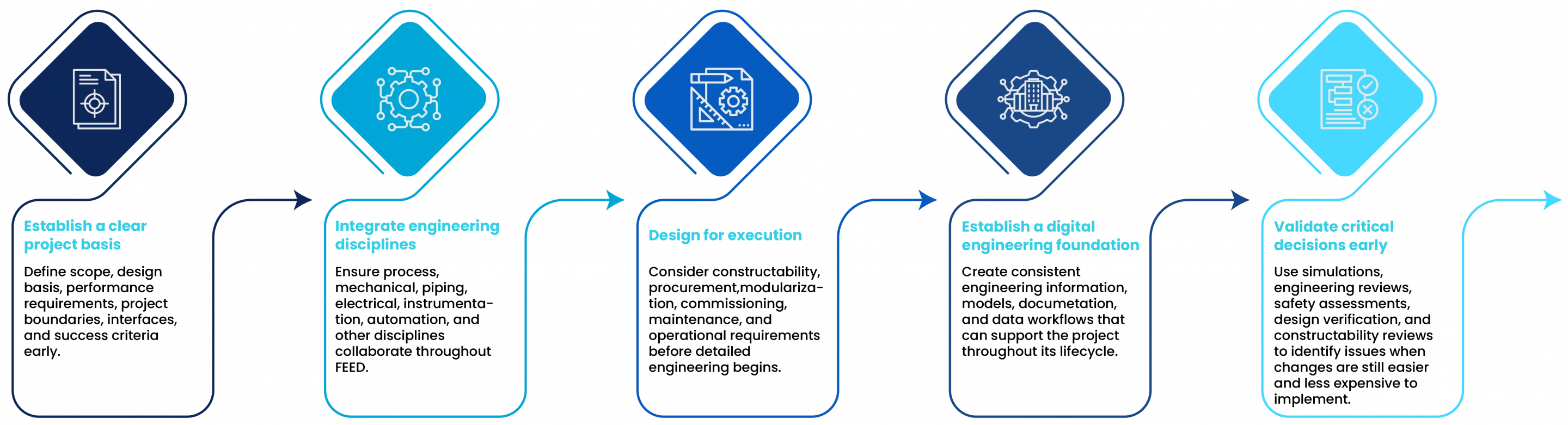
Five FEED Best Practices for Faster Project Delivery
Organizations looking to improve project execution can focus on five core practices:
Explore Utthunga’s Plant Engineering Services, covering Pre-FEED and FEED studies, basic and detailed engineering, multidisciplinary design, procurement support, site support, and commissioning.
Make FEED the Foundation for Faster Delivery
Industrial project delivery does not become faster simply by accelerating individual engineering activities. It becomes faster when uncertainty, design risks, and project interfaces are addressed before they become execution problems.
A disciplined FEED process provides the foundation for achieving this.
The goal of FEED should therefore go beyond completing engineering and create an execution-ready project.
With the right engineering approach and the right partner, FEED can become a strategic advantage helping industrial organizations reduce project risk, improve cost and schedule predictability, and move from concept to commissioning with greater confidence.
Partner with Utthunga for integrated Pre-FEED, FEED, detailed engineering, and commissioning support designed to reduce project risks and accelerate industrial project delivery.