
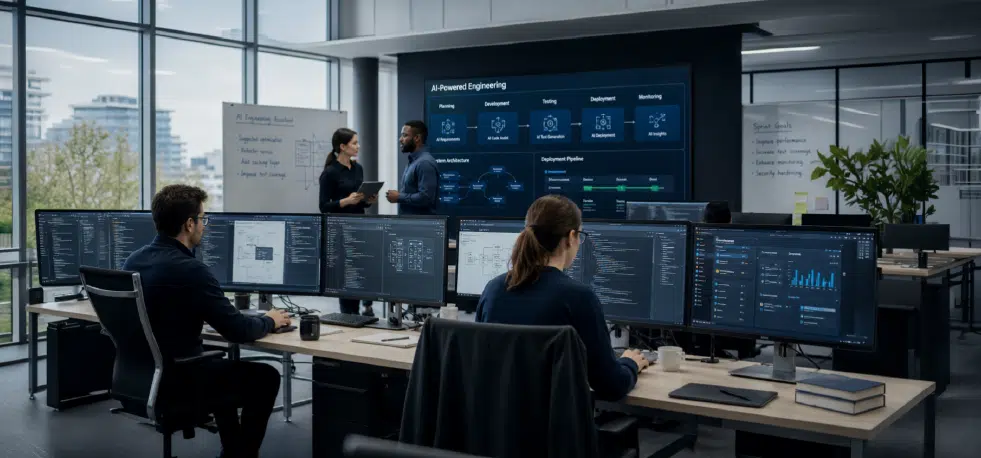
According to McKinsey’s report 20% of organizations are scaling software coding agents, rising to 31% among larger enterprises. Gartner predicts that by 2027, over 65% of engineering teams using agentic coding will treat Integrated Development Environments (IDEs) as optional, signalling a shift toward automated engineering platforms.
Yet, faster coding does not guarantee faster software delivery. Requirements, architecture, testing, security, and deployment must work together to deliver production-ready software.
The bigger question for technology leaders is: How quickly can we turn business requirements into secure, production-ready software?
The answer lies in moving beyond isolated AI coding assistants to integrated, AI-powered delivery across the entire SDLC.
AI Across the Agile Software Development Lifecycle (SDLC)
AI can enhance every stage of this lifecycle by helping teams make faster decisions, automate repetitive activities, improve code quality, and accelerate delivery.
- Product Backlog & Requirements: Analyze business requirements, identify gaps, prioritize backlog items, and generate user stories and acceptance criteria.
- Sprint Planning & Design: Support effort estimation, evaluate architectural options, identify dependencies, and assess potential design risks.
- Development: Accelerate code generation, refactoring, debugging, code reviews, and technical documentation.
- Continuous Testing & Security: Generate test cases, automate regression testing, analyze defects, identify vulnerabilities, and support security validation.
- Sprint Review, Release & Deployment: Summarize sprint outcomes, assess release readiness, and optimize Continuous Integration and Continuous Delivery (CI/CD) pipelines.
- Monitoring & Feedback: Analyze application logs, performance metrics, and user feedback to identify anomalies and generate insights for subsequent development cycles.

Utthunga Advantage: Engineering an AI Software Factory
Utthunga combines expertise across software and product engineering, Artificial Intelligence and Machine Learning (AI/ML), cloud engineering, cybersecurity, DevSecOps, Quality Assurance and Quality Operations (QAOps), and application modernization to establish an integrated AI-powered delivery ecosystem.
The Utthunga AI Software Factory can be deployed on-premises or within a Virtual Private Cloud (VPC), leveraging the organization’s preferred Large Language Model (LLM) endpoints and access controls. Human-in-the-loop governance and centralized dashboard visibility help maintain engineering quality, security, compliance, and delivery oversight.
For industrial enterprises, this integrated approach is particularly valuable. Software engineering extends beyond conventional applications to embedded systems, edge devices, industrial protocols, cloud platforms, and Operational Technology (OT) environments. Utthunga’s industrial engineering expertise helps connect these diverse technology layers while addressing their specific performance, interoperability, reliability, and security requirements.
The Future of Software Development: From AI-Assisted to AI-Driven SDLC
Utthunga’s accelerators integrate human intelligence with AI-driven automation, ensuring domain experts remain central to critical decisions, quality validation, and delivery outcomes. This human-in-the-loop approach combines the speed and scalability of AI with the expertise, judgment, and accountability needed to deliver reliable, high-quality results.
Key developments will include
- Autonomous Engineering: AI agents collaborating across development stages to reduce manual effort and handoffs.
- Predictive Quality: Early identification of defects, security vulnerabilities, and performance risks.
- Self-Optimizing Pipelines: AI-driven analysis to improve CI/CD efficiency and release cycles.
- Context-Aware Engineering: AI leveraging enterprise architecture, domain knowledge, and industrial context for relevant engineering outcomes.
- Intelligent Governance: Greater traceability, security controls, and human oversight across AI-driven workflows.
As these capabilities mature, development, testing, security, and operations will become increasingly interconnected through intelligent agents, shared knowledge, and continuous feedback.
For enterprises, the competitive advantage will come not from how much code AI generates, but from how effectively it transforms the entire software delivery lifecycle.
AI can accelerate coding. Connected intelligence can transform software delivery.
With its AI Centre of Excellence, multidisciplinary engineering expertise, and AI Software Factory, Utthunga helps enterprises move toward a more intelligent, integrated, and scalable software engineering future.
Ready to move from AI-assisted coding to AI-powered delivery? Explore Utthunga’s AI Software Factory.