
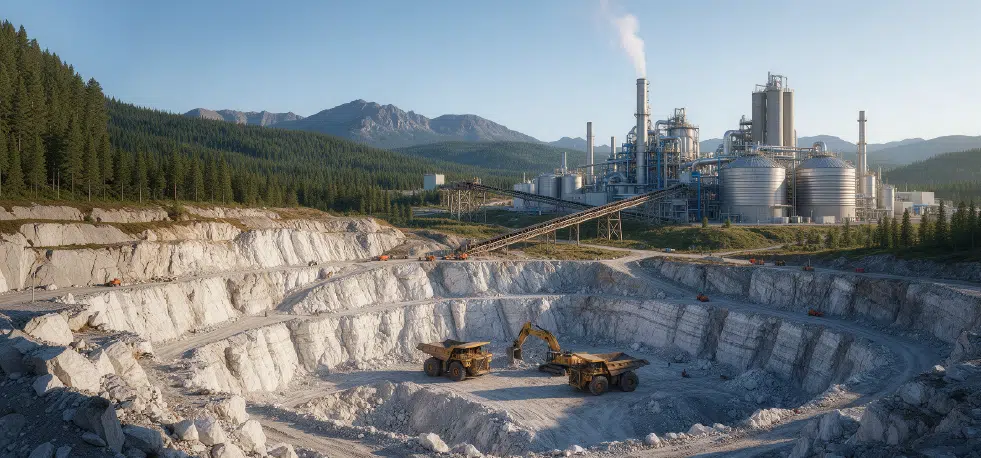
Canadian projects must address specific plant and process engineering challenges, from variable feedstocks and remote operating conditions to technology integration, processing infrastructure, and long-term plant reliability.
In this blog, we will explore five critical plant and process engineering priorities that Canadian lithium projects must address before moving to commercial scale:
1. Designing Processes for Variable Lithium Feedstocks
These variables influence mass balances, recovery, reagent consumption, equipment sizing, water requirements, and operating conditions.
Process engineers must develop realistic models and design bases that account for feed variability. Pilot results must be translated into commercial-scale equipment, process conditions, and operating envelopes that can deliver consistent performance.
The goal is not simply to scale up a process, but to create a robust process design capable of performing under real operating conditions.
2. Closing Gaps in Processing Infrastructure
Plant engineering must integrate process equipment, material handling, piping, utilities, instrumentation, automation, and supporting systems into a coordinated plant architecture.
For brownfield projects, the challenge is greater. New equipment and technologies must be integrated with existing assets while minimizing operational disruption.
Plant assessment, revamp engineering, debottlenecking, equipment replacement, and multidisciplinary coordination can help improve capacity and plant performance.
Take an assessment to find out what are your brownfield challenges
3. Engineering for Remote Locations and Challenging Climate Conditions
These conditions create specific requirements for winterization, insulation, heat tracing, freeze protection, equipment accessibility, utility reliability, transportation, installation, and maintenance.
Equipment selection must therefore go beyond technical specifications. Engineers must consider how equipment will be transported, installed, operated, serviced, and replaced throughout its lifecycle.
A commercially viable facility must be engineered for the actual environment in which it will operate.
4. Integrating Emerging Extraction Technologies at Commercial Scale
Commercial deployment requires integration with pretreatment, impurity management, fluid handling, regeneration, water treatment, reagent systems, purification, and downstream conversion.
Process simulation, equipment sizing, utility planning, automation, control philosophy, process safety, and operability assessments help translate pilot performance into a reliable commercial process train.
The technology may create the opportunity, but engineering integration determines how effectively it performs within the complete plant.
5. Building Engineering Capacity for Reliable Project Execution
Limited access to specialized engineering resources can put additional pressure on project schedules and execution teams. Digital engineering can help improve data consistency, design coordination, multidisciplinary collaboration, documentation, and lifecycle visibility.
Specialist engineering partners can further provide technical expertise during critical phases, helping project teams manage complex engineering requirements without compromising execution timelines.
Engineering Canada's Lithium Opportunity with Utthunga
Our capabilities span process, plant, equipment, automation, instrumentation, and digital engineering.
1. Process Engineering
2. Plant Engineering
3. Equipment Engineering
4. Automation & Instrumentation
5. Brownfield Modernization
6. Digital Engineering
7. Technology Integration
Ready to scale your lithium project?