Select Page

5 Warning Signs Your DLE Facility Is Leaving Recovery on the Table

Direct Lithium Extraction (DLE) is gaining momentum as lithium producers look for faster and more efficient ways to recover lithium from brines. But deploying DLE technology does not automatically mean a facility is achieving its full recovery potential. 

Recovery can be affected by brine variability, pretreatment, process conditions, equipment performance, and operational controls. 

Here are five warning signs that your DLE facility may be leaving recovery—and production value—on the table. 

1. Recovery Changes With Feed Conditions

Brine is not a constant input. Lithium concentration, temperature, pH, flow rate, and impurities can vary over time. 

If recovery changes significantly with feed conditions, the process may not be optimized for the actual brine entering the plant. 

Watch for: 

  • Variable lithium concentration 
  • Changing impurity levels
  • Unstable flow or temperature 
  • Recovery fluctuations without a clear cause 

Understanding the relationship between brine characteristics and recovery is the first step toward improving performance.

2. Pretreatment Is Affecting DLE Performance

DLE performance starts before the extraction stage. 

Solids, scaling compounds, organic matter, and other impurities can affect extraction media, membranes, solvents, and downstream equipment. 

Signs of a pretreatment problem include: 

  • Increasing fouling 
  • Frequent cleaning 
  • Pressure fluctuations 
  • Rising chemical consumption 
  • Declining extraction performance 

A stable pretreatment process creates the conditions for more consistent DLE recovery. 

The extraction stage can only perform as well as the feed preparation allows. 

3. Extraction and Regeneration Cycles Are Inefficient

DLE systems typically involve multiple cycles, including extraction, regeneration, washing, and lithium recovery. 

Small inefficiencies can accumulate into significant production losses. 

Long cycle times can reduce throughput, while incomplete regeneration can reduce extraction capacity in subsequent cycles. 

Operators should continuously monitor: 

Cycle time | Extraction efficiency | Regeneration performance | Lithium concentration | Chemical consumption 

The objective should be to optimize the complete operating cycle, not just one process parameter. 

4. You Have Data but Not Enough Operational Insight

DLE facilities can generate large volumes of process and equipment data. But more data does not automatically mean better recovery. 

If operators cannot connect changes in flow, pressure, chemistry, temperature, equipment condition, and recovery, important optimization opportunities can remain hidden. 

Industrial connectivity and analytics can help identify: 

  • Recovery deviations 
  • Process instability 
  • Equipment degradation 
  • Abnormal operating conditions 
  • Emerging bottlenecks 

Digital twins can also help evaluate process changes before they are introduced into the operating plant. 

The goal is not more data. It is better recovery decisions. 

5. You Know Recovery Is Falling—but Not Where

A recovery percentage tells you what happened. It does not necessarily tell you where the loss occurred. 

A stronger approach is to track lithium across the complete process: 

Brine Feed → Pretreatment → DLE → Regeneration → Concentration → Product Recovery 

This can reveal where lithium is being lost and which process stage offers the greatest opportunity for improvement. 

Instead of optimizing individual equipment, producers can then focus on end-to-end recovery performance. 

How Utthunga Can Help

Utthunga helps DLE technology providers and lithium producers connect process engineering, automation, industrial connectivity, and digital intelligence to improve plant performance. 

Its capabilities include: 

  • Process & Plant Engineering – identify constraints and recovery losses. 
  • Automation & Controls – improve process stability and control. 
  • Industrial Connectivity – connect equipment, control systems, and operational data. 
  • Digital Twin & Simulation – evaluate optimization scenarios. 
  • AI & Analytics – identify process deviations and performance patterns. 
  • Commissioning & Optimization – support the transition from pilot to stable operations. 

For DLE facilities, improving recovery is not about optimizing one number in isolation. It requires understanding how brine quality, pretreatment, extraction, regeneration, downstream processing, equipment, and controls work together. 

Recover More From the Process You Already Have

DLE’s commercial value depends on consistent performance under real operating conditions. 

If recovery fluctuates, pretreatment becomes unstable, cycles take longer than expected, operational data remains disconnected, or lithium losses cannot be traced, valuable production may be left on the table. 

The question is: 

Are you measuring recovery—or actively engineering it? 

By connecting engineering, automation, data, and continuous optimization, DLE operators can move toward higher recovery, more predictable production, and stronger commercial performance. 

Want to identify where your DLE facility may be losing recovery? Talk to Utthunga’s lithium engineering experts → 
The Role of AI and Analytics in Pharmaceutical Process Optimization

The Role of AI and Analytics in Pharmaceutical Process Optimization

AI adoption is accelerating across the pharmaceutical and life sciences industry. According to NVIDIA’s 2026 State of AI in Healthcare and Life Sciences report, 74% of pharmaceutical and biotechnology organizations are actively using AI, highlighting its growing role in driving innovation and operational excellence. At the same time, the global AI in pharmaceutical manufacturing market is projected to grow from USD 1.64 billion in 2026 to USD 12.90 billion by 2034, reflecting strong industry investment in AI-driven technologies. As manufacturers seek to improve efficiency, product quality, and compliance, AI and advanced analytics are enabling predictive maintenance, process optimization, and data-driven decision-making, paving the way for smarter and more resilient pharmaceutical operations. 

Why do AI and Analytics matter in pharmaceutical manufacturing?

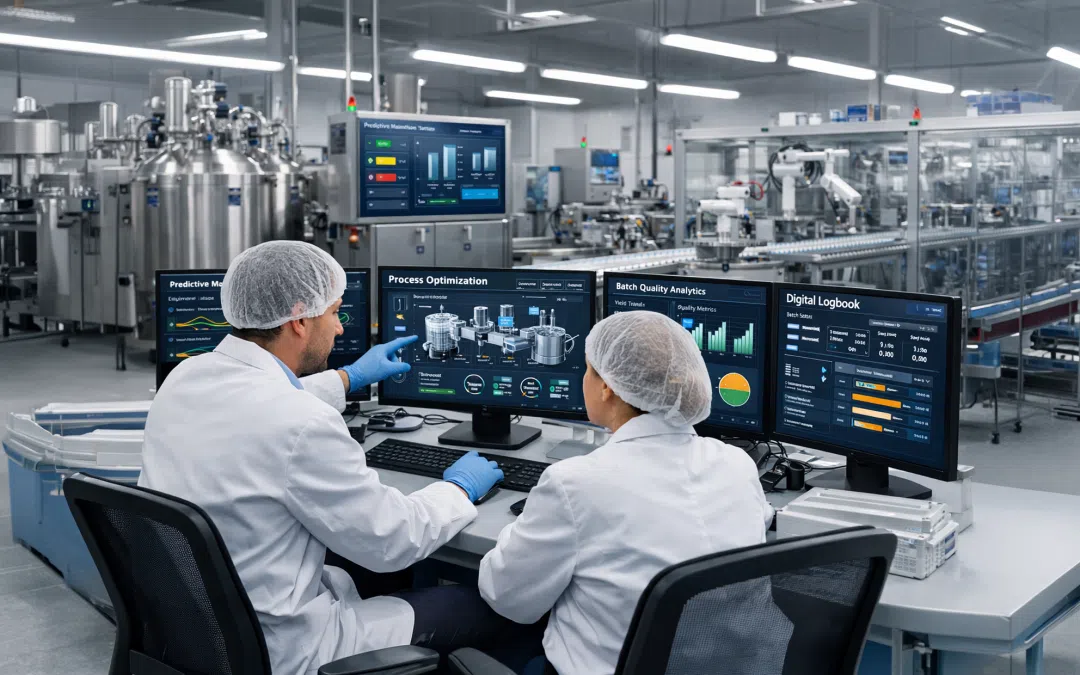
Pharmaceutical manufacturing involves interconnected processes, from raw material handling and formulation to production, quality control, and packaging. These operations generate significant data through equipment, process control systems, environmental monitoring, and quality management applications. 

However, disconnected systems make it difficult to identify inefficiencies, maintain consistency, and make timely decisions. 

Key applications of AI and Analytics in the pharmaceutical industry

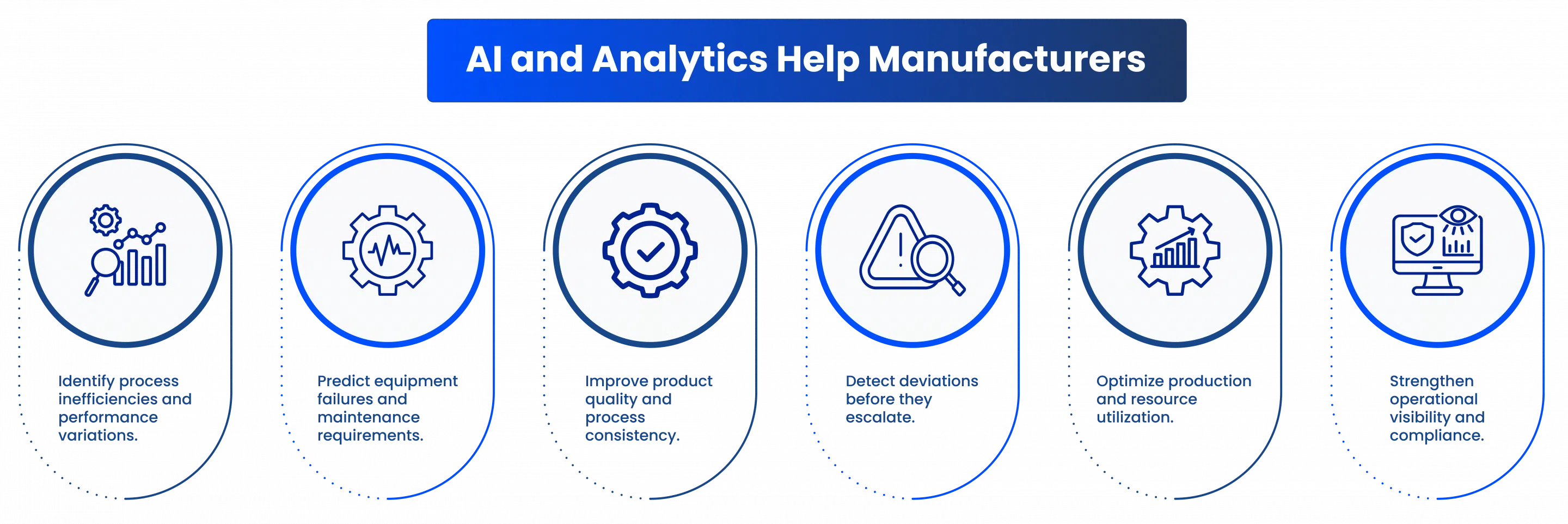
1. Predictive Process Monitoring

AI analyzes historical and real-time process data to identify patterns, detect abnormal conditions, and flag potential deviations, helping teams address issues before they affect product quality or production efficiency. 

2. Predictive Maintenance

By analyzing equipment performance, sensor readings, and maintenance records, AI identifies early signs of equipment deterioration. This enables proactive maintenance, reduces unplanned downtime, and improves asset reliability. 

3. Batch Performance Optimization

Advanced analytics evaluates process parameters and batch performance to identify conditions associated with consistent production outcomes. These insights support process optimization, repeatability, and production planning. 

4. Quality Monitoring and Deviation Management

AI identifies unusual patterns in manufacturing and quality data, helping teams investigate deviations, understand potential causes, and strengthen quality management. 

5. Root Cause Analysis

Analytics correlates equipment, process, and production data to uncover relationships behind operational issues, enabling faster investigations and informed corrective actions. 

How Utthunga supports pharmaceutical process optimization?

Utthunga combines engineering expertise, industrial automation, and digital technologies to help pharmaceutical manufacturers build connected, data-driven operations. 
Our capabilities include: 

  • Pharmaceutical Factory Automation: Integrated and efficient manufacturing operations. 
  • Process Automation and Control Systems: Process monitoring, control, and consistency. 
  • Building Management Systems (BMS): Integrated building infrastructure monitoring. 
  • Environmental Monitoring Systems (EMS): Visibility into critical environmental conditions. 
  • Industrial Internet of Things (IIoT): Connected assets and accessible operational data. 
  • Advanced Analytics and Visualization: Actionable insights for performance monitoring. 
  • Predictive Maintenance: Proactive asset maintenance strategies. 
  • Digital Twins: Data-driven visibility into assets and processes. 
  • OT-IT Integration: Connected plant-floor and enterprise systems. 

Enabling the future of pharmaceutical manufacturing

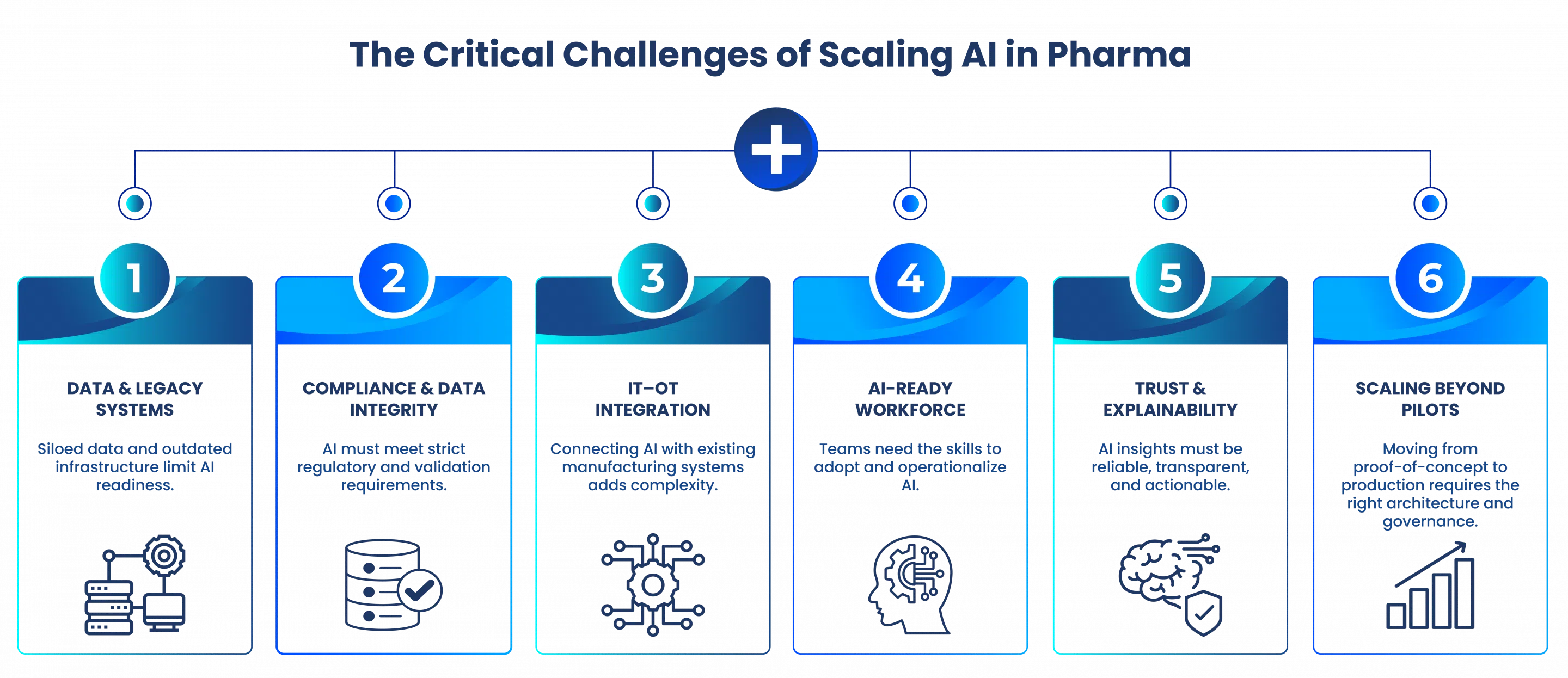
AI and analytics are transforming pharmaceutical manufacturing by driving smarter decisions, predictive operations, and greater process efficiency. While challenges such as data quality, regulatory compliance, system integration, and workforce readiness remain, the opportunities far outweigh the complexities. By building a strong digital foundation and effectively integrating AI into manufacturing processes, pharmaceutical companies can enhance product quality, improve operational performance, reduce risks, and accelerate innovation. As adoption continues to grow, AI-powered manufacturing will play a pivotal role in creating more agile, compliant, and future-ready pharmaceutical operations. 

Accelerate Pharmaceutical Manufacturing Transformation

Explore how Utthunga brings together engineering expertise, digital technologies, and Industrial AI to enable smarter, more connected operations.

→ Explore Pharmaceutical Industry Solutions

What Canadian Lithium Projects Must Solve Before Commercial Scale?

What Canadian Lithium Projects Must Solve Before Commercial Scale?

Canada is emerging as an important player in the global lithium supply chain. But moving from lithium resources and pilot projects to reliable commercial production requires more than extraction technology.

Canadian projects must address specific plant and process engineering challenges, from variable feedstocks and remote operating conditions to technology integration, processing infrastructure, and long-term plant reliability.

In this blog, we will explore five critical plant and process engineering priorities that Canadian lithium projects must address before moving to commercial scale:

1. Designing Processes for Variable Lithium Feedstocks

Canadian lithium projects can involve different resource characteristics and processing routes, including hard-rock deposits and lithium-bearing brines. Variations in lithium concentration, mineralogy, impurities, moisture, and feed properties can significantly affect process performance.

These variables influence mass balances, recovery, reagent consumption, equipment sizing, water requirements, and operating conditions.

Process engineers must develop realistic models and design bases that account for feed variability. Pilot results must be translated into commercial-scale equipment, process conditions, and operating envelopes that can deliver consistent performance.

The goal is not simply to scale up a process, but to create a robust process design capable of performing under real operating conditions.

2. Closing Gaps in Processing Infrastructure

Strengthening Canada’s domestic lithium supply chain will require greater extraction and processing capacity. Projects may need to develop new facilities or modernize existing processing infrastructure.

Plant engineering must integrate process equipment, material handling, piping, utilities, instrumentation, automation, and supporting systems into a coordinated plant architecture.

For brownfield projects, the challenge is greater. New equipment and technologies must be integrated with existing assets while minimizing operational disruption.

Plant assessment, revamp engineering, debottlenecking, equipment replacement, and multidisciplinary coordination can help improve capacity and plant performance.

Take an assessment to find out what are your brownfield challenges

3. Engineering for Remote Locations and Challenging Climate Conditions

Many Canadian lithium projects are located in remote regions where long logistics routes, limited infrastructure, severe winters, and restricted construction windows can influence plant design and execution.

These conditions create specific requirements for winterization, insulation, heat tracing, freeze protection, equipment accessibility, utility reliability, transportation, installation, and maintenance.

Equipment selection must therefore go beyond technical specifications. Engineers must consider how equipment will be transported, installed, operated, serviced, and replaced throughout its lifecycle.

A commercially viable facility must be engineered for the actual environment in which it will operate.

4. Integrating Emerging Extraction Technologies at Commercial Scale

Direct Lithium Extraction (DLE) and other emerging technologies are creating new opportunities for lithium production. However, demonstrating an extraction technology at pilot scale is only the beginning.

Commercial deployment requires integration with pretreatment, impurity management, fluid handling, regeneration, water treatment, reagent systems, purification, and downstream conversion.

Process simulation, equipment sizing, utility planning, automation, control philosophy, process safety, and operability assessments help translate pilot performance into a reliable commercial process train.

The technology may create the opportunity, but engineering integration determines how effectively it performs within the complete plant.

5. Building Engineering Capacity for Reliable Project Execution

Commercial lithium projects require multidisciplinary expertise across process engineering, equipment engineering, piping, instrumentation, automation, utilities, process safety, commissioning, and operations.

Limited access to specialized engineering resources can put additional pressure on project schedules and execution teams. Digital engineering can help improve data consistency, design coordination, multidisciplinary collaboration, documentation, and lifecycle visibility.

Specialist engineering partners can further provide technical expertise during critical phases, helping project teams manage complex engineering requirements without compromising execution timelines.

Engineering Canada's Lithium Opportunity with Utthunga

Utthunga brings end-to-end engineering expertise to help lithium producers, developers, and technology providers design, integrate, modernize, and scale processing plants.

Our capabilities span process, plant, equipment, automation, instrumentation, and digital engineering.

1. Process Engineering

Process design, simulation, optimization, scale-up, and equipment sizing.

2. Plant Engineering

Plant layout, piping, utilities, material handling, and multidisciplinary design.

3. Equipment Engineering

Equipment selection, specifications, sizing, integration, and replacement.

4. Automation & Instrumentation

Control systems, instrumentation, automation architecture, and plant integration.

5. Brownfield Modernization

Plant assessment, debottlenecking, revamp engineering, technology integration, and capacity expansion.

6. Digital Engineering

Connected workflows, design coordination, engineering data, and lifecycle documentation.

7. Technology Integration

Engineering integration and scale-up of emerging technologies, including Direct Lithium Extraction (DLE).
From greenfield development to brownfield modernization and DLE scale-up, Utthunga connects process intent with plant execution to build reliable, scalable lithium operations.

Ready to scale your lithium project?

Talk to Utthunga’s Lithium Engineering Experts 

Top Challenges Faced by Lithium Producers in 2026 and Beyond

Top Challenges Faced by Lithium Producers in 2026 and Beyond

The global push toward electrification is driving unprecedented demand for lithium. As producers work to increase output, control costs, meet environmental requirements, and adopt next-generation extraction technologies, scaling lithium production is becoming increasingly complex. 

With Direct Lithium Extraction (DLE) gaining momentum, the challenge is no longer simply proving that lithium can be extracted, but it is making the technology work reliably on a commercial scale. This requires addressing the engineering, process, integration, and operational challenges that can stand between a successful pilot and a viable production facility. 

In this blog, we explore the key challenges facing DLE projects and the engineering solutions that can help overcome them enabling a more reliable path from pilot to commercial-scale lithium production 

Engineering Challenges in Modern Lithium Production

1. Scaling Production Without Increasing Risk

Moving from pilot-scale success to commercial production requires overcoming significant changes in process conditions, equipment, utilities, material handling, and control strategies to achieve reliable industrial-scale operations. 

Successful scale-up requires more than process validation. It demands integrated engineering covering equipment selection, plant layout, piping, instrumentation, automation, and process integration. The objective is a facility that operates continuously, efficiently, and safely while maintaining long-term reliability.

2. Managing Brine Chemistry, Water, and Environmental Constraints

A resource-specific engineering strategy can improve plant performance while reducing operational and environmental risks.

By considering resource characteristics, process conditions, equipment requirements, and DLE technology together, producers can develop an integrated plant design optimized for efficiency, reliability, and commercial-scale production.

3. Turning DLE Potential into Commercial Reality

DLE has emerged as a promising alternative to conventional evaporation-based methods, enabling selective lithium recovery from challenging brines. However, pilot-scale results are only the beginning of commercialization. 

Full-scale deployment raises critical questions: 

  • How should the brine be pre-treated? 
  • How will impurities affect extraction efficiency? 
  • Can extraction and regeneration cycles remain stable? 
  • How can fluid movement be managed reliably? 
  • How will DLE integrate with downstream conversion? 
  • Can the process remain economical and continuous at scale? 

The real differentiator is how effectively process, plant, equipment, automation, utilities, and multidisciplinary engineering are integrated to turn DLE potential into a reliable commercial-scale operation. 

4. Modernizing Existing Lithium Infrastructure

Not every lithium producer can build a new facility from the ground up. Brownfield modernization can unlock capacity and performance through debottlenecking, equipment replacement, process optimization, plant modifications, and DLE integration. 

A detailed assessment of existing equipment, layouts, utilities, process flows, and control systems helps identify practical upgrade opportunities while minimizing production downtime and execution risks. 

Book a Plant Visit to assess your plant’s modernization potential. 

What Successful Lithium Scale-Up Requires

Technology alone cannot address the complexities of commercial lithium production. Long-term success requires an engineering foundation that combines: 

  • Resource-specific process and plant design 
  • Equipment engineering and integration 
  • Multidisciplinary design coordination 
  • Instrumentation and control engineering 
  • Greenfield and brownfield expertise 
  • Digital engineering capabilities 
  • Reliability, maintainability, and scalability planning 

Integrating these capabilities early can help reduce execution risk, improve operational performance, and prepare facilities for future growth.

Engineering the Path from Resource to Production

As lithium production evolves, engineering remains the critical link between resource potential and commercial success. Whether developing new facilities, expanding existing operations, or implementing DLE, producers need integrated solutions that connect process requirements with practical, scalable plant design. 

Utthunga brings together process engineering, plant engineering, multidisciplinary design, digital engineering, and industrial technology expertise to support lithium projects across greenfield and brownfield environments. 

The future of lithium depends not only on better extraction technologies, but on the ability to engineer, integrate, and operate those technologies reliably at commercial scale. 

Talk to Our Lithium Engineering Experts → 

Why Modern Manufacturing Requires Digital-First Plant Engineering?

Why Modern Manufacturing Requires Digital-First Plant Engineering?

Manufacturing is entering an era where speed, flexibility, sustainability, and operational intelligence are becoming critical to competitiveness.

Rising customer expectations, supply chain disruptions, skilled-labor constraints, stricter environmental requirements, and rapid advances in automation are forcing manufacturers to rethink how plants are designed, built, operated, and modernized.

At the center of this transformation is plant engineering.

Traditional engineering approaches were designed to deliver facilities that met production, cost, quality, and safety requirements. But today’s plants must do much more. They need to adapt quickly, integrate emerging technologies, support data-driven decisions, and remain resilient throughout their lifecycle.

This is driving the shift toward digital-first plant engineering, an approach where connected data, digital technologies, and lifecycle intelligence become part of engineering decisions from the very beginning.

Why is Traditional Plant Engineering No Longer Enough?

For decades, plant engineering was largely document-driven. Process diagrams, P&IDs, equipment layouts, electrical drawings, instrumentation schedules, and construction documents were often developed and managed independently. 

This model worked when plants changed slowly, and engineering information was primarily needed for construction and handover. 

Today, that assumption no longer holds. 

Manufacturing facilities are becoming more connected and complex, while production environments are expected to respond faster to market changes. Production lines are frequently upgraded, new products require rapid reconfiguration, automation technologies evolve continuously, and sustainability requirements are becoming increasingly stringent. 

At the same time, Industry 4.0 initiatives are increasing demand for: 

  • Connected assets and real-time production visibility 
  • Digital twins and simulation 
  • Industrial IoT and edge computing 
  • Predictive maintenance 
  • AI-driven decision-making 
  • Advanced automation 
  • Energy and resource optimization 

These technologies depend on one critical foundation: accurate, connected, and structured engineering information. 

Digital-first plant engineering addresses this need by creating a connected engineering ecosystem that spans planning, design, construction, commissioning, operations, maintenance, and future modernization. 

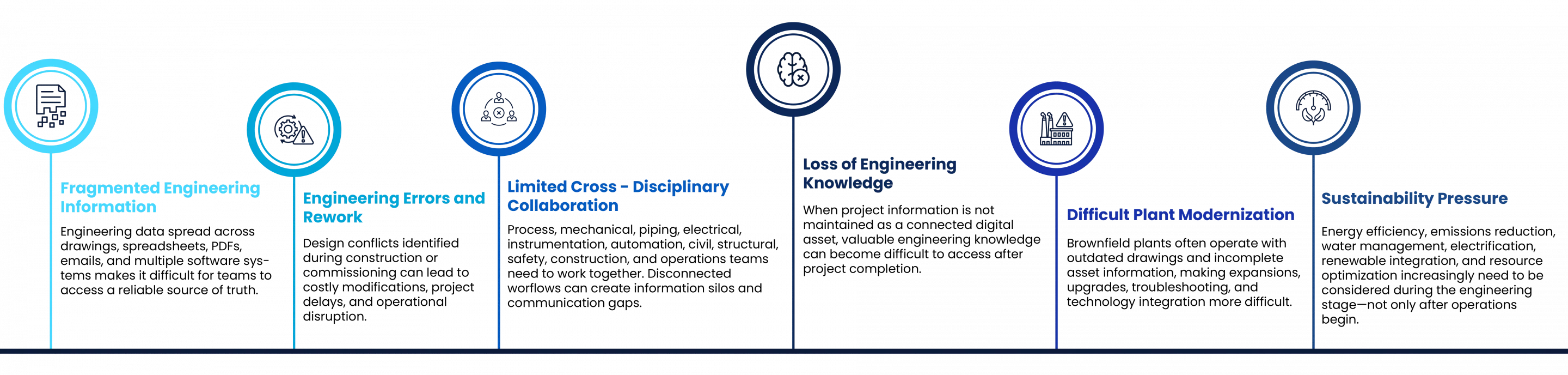
Key Challenges Facing Modern Manufacturers

As plants become more complex, conventional engineering approaches can create significant operational and business challenges. 

How do we enable Digital-First Plant Engineering?

The shift to digital-first engineering requires more than adopting individual software tools. It requires engineering expertise, connected information, technology integration, and lifecycle thinking. 

This is where Utthunga can serve as a transformation partner for manufacturers looking to modernize engineering and plant operations. 

Engineering Across the Plant Lifecycle

We bring engineering and digital capabilities together to help organizations move from project-centric engineering toward lifecycle-oriented plant engineering. 

The objective is to ensure that engineering information remains valuable beyond design and construction supporting commissioning, operations, maintenance, modernization, and future expansion. 

Connected Engineering Data

Digital-first engineering depends on a reliable digital source of truth. 

By connecting engineering information across disciplines and systems, organizations can reduce information silos, improve accessibility, and enable teams to make decisions using consistent and current data. 

Digital Engineering and Intelligent Design

Modern engineering environments can combine intelligent 3D plant design, BIM, engineering data management, process simulation, automated documentation, and digital twins. 

These capabilities enable engineering teams to identify design issues earlier, improve visualization, accelerate collaboration, and reduce downstream rework. 

Digital Twin Enablement

Digital twins create a digital representation of physical assets and allow engineering information to be connected with operational data. This can support scenario simulation, process optimization, maintenance planning, energy optimization, equipment performance analysis, and operator training. 

Enabling Smart Manufacturing

Digital-first engineering creates the information foundation required for Industry 4.0 technologies. Connected engineering data can support Industrial IoT, predictive maintenance, industrial AI, edge computing, real-time monitoring, digital twins, enterprise analytics, and intelligent autonomous operations. 

Sustainability by Design

Sustainability increasingly starts during engineering. Digital tools can help teams evaluate energy consumption, equipment selection, material usage, water management, process efficiency, emissions, electrification, renewable integration, and waste heat recovery before construction begins. 

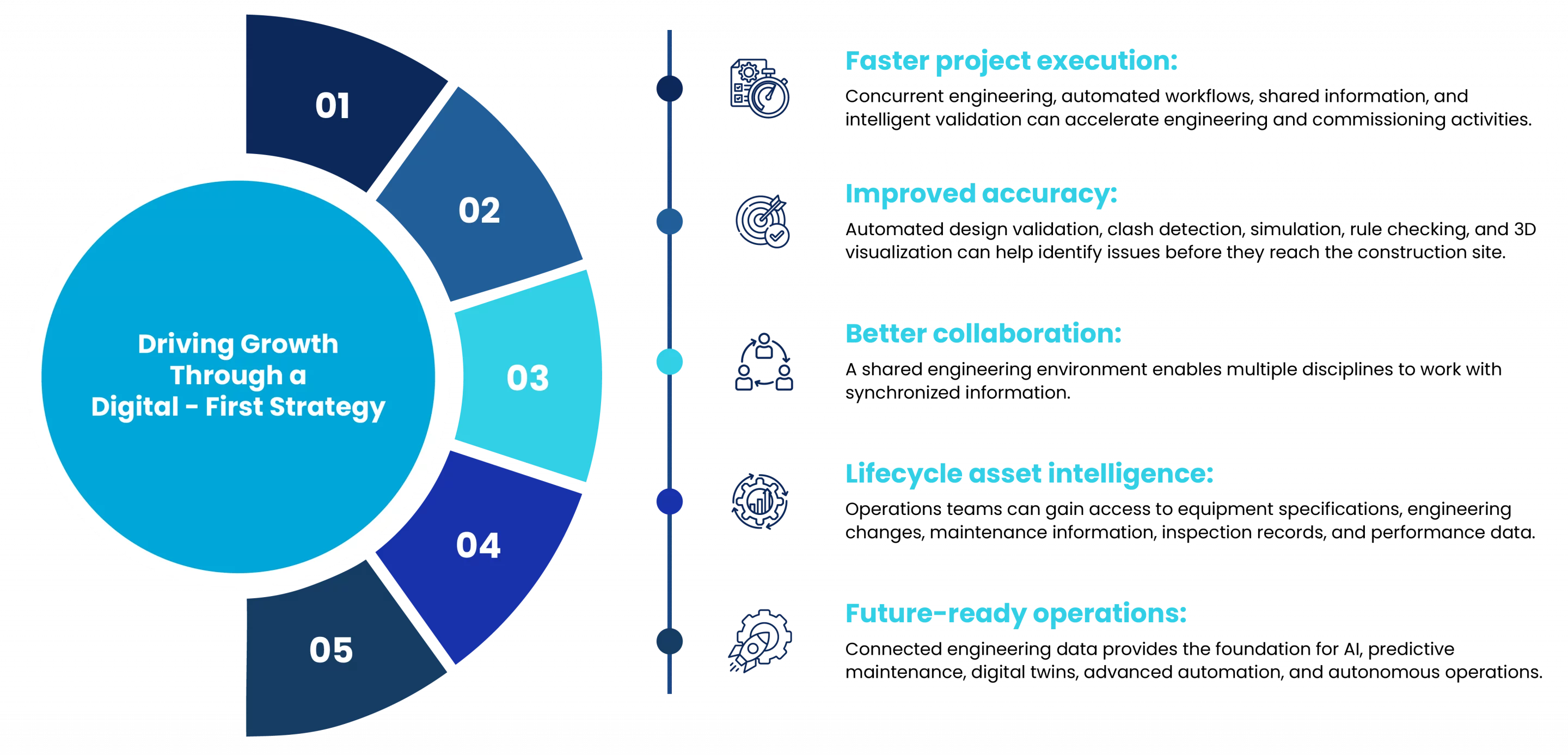
Driving Growth Through a Digital-First Strategy

A digital-first approach can create value across the plant lifecycle. 

Data Is the New Engineering Deliverable

The value of an engineering project no longer ends with a handover package of drawings and manuals. Manufacturers increasingly need structured, connected, searchable engineering data that can support operations, maintenance, compliance, digital transformation, and future expansion. Engineering is no longer simply about creating the plant. 

It is about creating the digital foundation that helps the plant perform, adapt, and evolve.

Build Plants That Are Ready for What Comes Next

The next generation of manufacturing will be shaped by AI, robotics, advanced automation, connected supply chains, intelligent production systems, and increasingly autonomous operations. With the right engineering expertise, digital technologies, and lifecycle approach, plants can become more agile, intelligent, sustainable, and ready for continuous modernization. 

Whether you’re developing a greenfield facility, modernizing a brownfield plant, expanding production capacity, or advancing your Industry 4.0 roadmap, a digital-first engineering approach can help create measurable value across the asset lifecycle. 

Partner with Utthunga to connect engineering, digital technologies, and operational intelligence—and build manufacturing facilities designed for the future. 

Never Miss an Update